
Why Multi-Family Offices Are on the Rise in 2026: Family, Legacy and Generational Planning

Key Points:
An estimated $124 trillion is expected to transfer across U.S. generations through 2048, putting legacy planning at the center of many family conversations.
As family finances grow more complex, a multi-family office could offer coordinated support without the cost and staffing of a standalone single-family office.
Succession planning is shifting from documents alone toward preparing the people who will inherit both assets and responsibility.
Family governance could help growing, multigenerational families work through differing views on money, values, investments and control.
Most families spend decades building wealth. Far fewer spend time planning how that wealth, and the responsibility that comes with it, will move to the next generation. That gap is one reason multi-family office structures are drawing more attention in 2026.
As the generational wealth transfer picks up speed, many families are looking for legacy planning support that goes beyond investment management. They want a single, coordinated view of their investments, taxes, estate plans, philanthropy and family dynamics, along with a framework for passing it all on.
This article explains what a multi-family office is, why the model is growing and how it fits into long-term legacy and succession planning.
What Is a Multi-Family Office?
A multi-family office is an advisory firm that provides family office-style services to several families at once. Instead of one wealthy family hiring its own dedicated staff, a multi-family office shares a team of specialists across a group of client families.
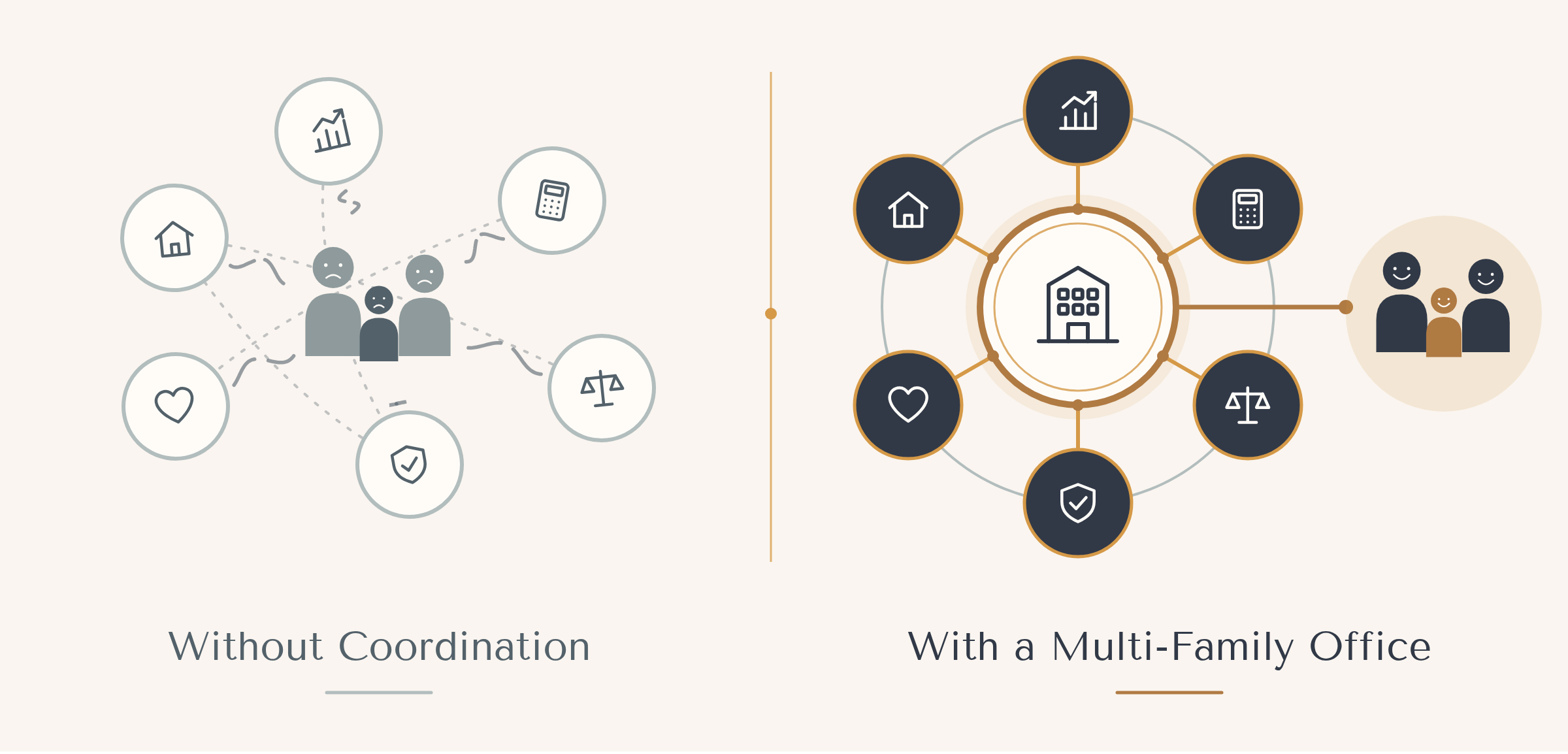
Services often include:
Investment management and oversight
Tax planning and coordination
Estate and legacy planning
Charitable giving strategies
Risk management and insurance review
Family governance and next-generation education
Think of it as a middle ground. A traditional wealth management relationship usually centers on the investment portfolio. A single-family office is a private company built to serve one family, which typically requires significant assets, staff and overhead to justify. A multi-family office sits between the two, offering broad coordination at a scale that could make sense for more families.
The Great Wealth Transfer Is Already Under Way
The numbers behind generational wealth transfer are large. According to Cerulli Associates, total U.S. wealth transfers are projected to reach $124 trillion through 2048. Of that, about $105 trillion is expected to pass to heirs and $18 trillion to charity.
Cerulli also projects that more than $62 trillion, roughly half of the total, will come from high-net-worth and ultra-high-net-worth households, even though those households make up only about 2% of the population.
For families on the giving side, this raises practical questions:
Who will inherit, and when?
Are the heirs ready to manage what they receive?
How will taxes, trusts and charitable goals be coordinated?
What happens to a family business or shared real estate?
For families on the receiving side, the questions are just as real. Inheriting wealth often means inheriting decisions, relationships with advisors and, in some cases, a role in a family enterprise.
Why Family Finances Are Getting More Complex
Wealth rarely stays simple as it grows. A family that started with a home, retirement accounts and a brokerage account may, over time, add:
Equity compensation or a concentrated stock position
Ownership in a private or family business
Real estate across multiple states
Trusts for children and grandchildren
Donor-advised funds or a private foundation
Heirs living in different places with different financial needs
Each piece may involve its own attorney, CPA, insurance agent or investment manager. When those professionals do not talk to each other, important details could fall through the cracks. A trust might be drafted without a clear investment policy. A charitable gift might be timed without considering its tax impact.
Where a Multi-Family Office Fits
This growing complexity is making the multi-family office model attractive to families who want more than a traditional wealth management relationship but do not need, or want, to build their own single-family office. The appeal is coordination: one team that sees the full picture and helps each advisor work from the same plan.
investment management services
Succession Planning Is Now About People, Not Just Documents
For generations, succession planning meant wills, trusts and powers of attorney. Those documents still matter. But families are recognizing that paperwork alone does not prepare an heir to make sound decisions.
Recent research points to a gap. The UBS Global Family Office Report 2026 found that only 27% of family offices have a structured process to educate and prepare heirs for future roles. Only 35% have a defined succession plan for the family office itself.
In other words, many families have a plan for the assets but not for the people.
People-focused succession planning could include:
Introducing heirs to the family's advisors well before a transition
Teaching financial basics, from budgeting to reading an investment statement
Sharing the family's history, values and intentions behind its wealth
Gradually involving the next generation in decisions, such as charitable giving
Clarifying who will hold decision-making roles, and how those roles will change over time
A multi-family office could help by bringing structure to these conversations, so preparation happens over years rather than all at once.
Why Governance Matters as Families Grow
A family with two parents and three children is one thing. Add spouses, grandchildren and multiple family branches, and decisions about money become far more complicated.
Disagreements could arise over how to invest shared assets, whether to sell or keep a family business, how much to give to charity or who gets a say in major decisions. According to the J.P. Morgan Private Bank 2026 Global Family Office Report, 41% of business-owning families cite internal conflict as a top-three risk, compared with 23% of non-business owners.
That finding helps explain why family governance is becoming an important part of long-term planning.
What Family Governance Could Include
Family governance is simply a set of agreed-upon rules and practices for how a family makes decisions about shared wealth. It could include:
A family mission statement that describes shared values and goals
Regular family meetings to review plans and share updates
Clear decision-making roles, including who votes on what
A process for resolving disagreements before they escalate
Education programs for younger family members
Governance does not need to be formal or rigid. For many families, it starts with a single honest conversation and grows from there.
Questions to Ask Before Choosing a Planning Structure
Every family is different, and a multi-family office is not the right fit for everyone. Before deciding how to organize your planning, it could help to consider:
How many advisors does our family currently work with, and do they coordinate?
Do our heirs understand what they may inherit and what will be expected of them?
Do we have a plan for passing on decision-making roles, not just assets?
How do we handle disagreements about money today?
Would a single coordinating team simplify our financial life?
Your answers could point toward the level of support that makes sense for your family.
A Coordinated Framework for What Comes Next
The rise of multi-family offices is not simply about wealthy families wanting better investment management. It reflects a growing need for a coordinated framework to navigate increasingly complex wealth, multiple generations and the eventual transfer of both assets and responsibility.
Starting these conversations early gives families more time to prepare heirs, set up governance and align every part of the plan.
If you would like to talk through how legacy and generational planning could apply to your family, contact Capstone Financial Advisors. You can also explore our services or subscribe to our newsletter for more insights on family wealth planning.
FAQs
Q: What is a multi-family office?
A multi-family office is an advisory firm that provides family office-style services, such as investment management, tax planning, estate planning and family governance, to several families at once. Families share a team of specialists instead of hiring dedicated staff.
Q: How is a multi-family office different from a single-family office?
A single-family office is a private company created to serve one family and typically requires significant assets and overhead. A multi-family office serves multiple families, which spreads costs and could make coordinated services accessible to more households.
Q: How is a multi-family office different from traditional wealth management?
Traditional wealth management generally focuses on the investment portfolio. A multi-family office usually coordinates a broader set of needs, including taxes, estate plans, philanthropy, risk management and next-generation education.
Q: What is the great wealth transfer?
The great wealth transfer refers to the movement of assets from older generations to heirs and charities. Cerulli Associates projects $124 trillion in U.S. wealth transfers through 2048.
Q: Why is family governance important in legacy planning?
Family governance sets shared rules for making decisions about wealth. As families grow into multiple branches, governance could help reduce conflict, clarify roles and keep planning aligned with the family's values.
Q: When should families start succession planning?
Many families benefit from starting years before a transition. Early planning allows time to prepare heirs, introduce them to advisors and put governance practices in place.
Sources
Cerulli Associates, "Cerulli Anticipates $124 Trillion in Wealth Will Transfer Through 2048," December 5, 2024. cerulli.com
UBS, "UBS Global Family Office Report 2026," May 28, 2026. ubs.com
J.P. Morgan Private Bank, "J.P. Morgan Private Bank Releases 2026 Global Family Office Report," PR Newswire, February 2026. prnewswire.com
IMPORTANT DISCLOSURE INFORMATION:
This article is not a substitute for personalized advice from Capstone and nothing contained in this presentation is intended to constitute legal, tax, accounting, securities, or investment advice, nor an opinion regarding the appropriateness of any investment, nor a solicitation of any type. This article is current only as of the date on which it was sent. The statements and opinions expressed are, however, subject to change without notice based on market and other conditions and may differ from opinions expressed by other businesses and activities of Capstone. Descriptions of Capstone’s process and strategies are based on general practice, and we may make exceptions in specific cases. A copy of our current written disclosure statement discussing our advisory services and fees is available for your review by contacting us at capstonefinancialadvisors@capstone-advisors.com or (630) 241-0833.