
Why Have Stocks Withstood Higher Rates?

KEY POINTS:
Markets: Global stocks advanced during the third quarter, while rising yields weighed on bonds. Earnings growth should support stocks, and higher yields should help improve expected future bond returns, although persistent inflation and higher borrowing costs remain important risks.
Economy: Consumer spending and business investment supported continued growth despite modest hiring and persistent inflation. Further economic growth remains the base case, with the pace of inflation determining how many additional Fed rate hikes may be needed.
On the Minds of Investors: Strong earnings among the largest tech companies have helped the aggregate stock market withstand higher interest rates. Whether that support lasts depends partly on profits meeting expectations and the economy continuing to absorb higher borrowing costs.
Portfolio Management: Stock gains and bond losses reinforced the importance of diversification and disciplined rebalancing. Moreover, deliberate year-end tax-loss harvesting may offer opportunities to offset future taxable gains while preserving the portfolio’s intended exposures and alignment with long-term objectives.
MARKET REVIEW
STOCKS ADVANCED WITH UNEVEN PARTICIPATION
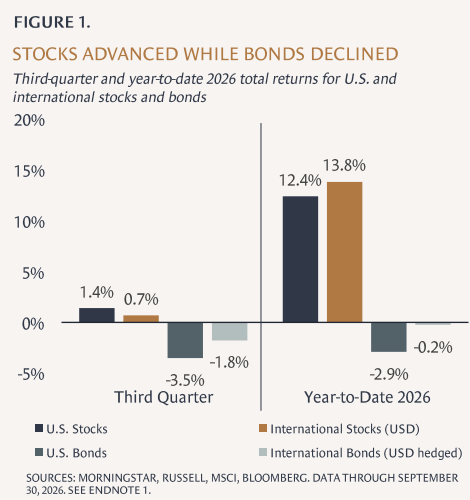
Global stocks posted modest third-quarter gains as corporate earnings and continued economic expansion helped offset pressure from rising interest rates and renewed tensions in the Middle East. Technology stocks benefited from AI-related demand, while higher oil prices supported energy companies; U.S. small-company stocks declined as returns remained uneven across the broader market. U.S. stocks, in aggregate, outperformed international stocks during the quarter, although international markets remained ahead for the year to date. Both retained substantial year to date gains through September despite the more challenging conditions late in the third quarter (see Figure 1).
RISING YIELDS WEIGHED ON BONDS
Bond yields rose across major markets, producing quarterly losses in both U.S. and international bonds. Both have also posted losses for the year to date through September. Strong economic activity, persistent inflation, and renewed energy pressures contributed to expectations for tighter monetary policy, while the Federal Reserve raised its policy rate in September. Rising yields reduced bond prices, with longer-term bonds generally posting larger losses.
MUNICIPAL BONDS FACED ADDITIONAL PRESSURE
Municipal bonds faced additional pressure as selling and supply-and-demand imbalances compounded the effects of rising interest rates. Tax-loss selling intensified late in the quarter, worsening trading conditions and pushing prices lower. Still, though, the municipal bond price declines occurred alongside generally solid state finances.
MARKET OUTLOOK
EARNINGS GROWTH SHOULD SUPPORT STOCKS
Continued economic expansion and business investment should support corporate earnings, providing a foundation for further stock gains over the coming quarter and year. Earnings expectations have risen faster than stock prices, bringing valuations down from earlier levels. Earnings growth across more industries and regions could also support broader market participation. Higher financing costs and substantial concentration in major technology companies remain important risks, particularly if their profits fall short of expectations.
HIGHER YIELDS STRENGTHEN THE BOND OUTLOOK
Higher starting yields provide a stronger foundation for future bond returns, with income helping to cushion the impact of further price declines. Clearer inflation progress could limit the need for additional policy tightening and support bond prices, while persistent price pressures, government borrowing, and private investment needs could keep yields elevated. Although risks remain, higher yields mean bonds have greater potential to generate meaningful returns from income without depending on a decline in rates.
ENERGY AND POLICY REMAIN IMPORTANT VARIABLES
A prolonged disruption to energy supplies could pressure corporate margins and reinforce inflation, making conditions more difficult for both stocks and bonds. Conversely, easing oil supply pressures could reduce inflation and ease pressure on business costs and household budgets. The approaching midterm elections may add to near-term volatility as investors assess possible changes in tax, spending, and regulatory policy. Over time, what matters most is how those changes affect business profits and economic growth.
ECONOMIC REVIEW
SPENDING AND INVESTMENT SUSTAINED GROWTH
Economic data pointed to continued U.S. growth during the third quarter, supported by consumer spending and strong business investment. Investment in artificial intelligence and related infrastructure remained an important source of activity. Household spending also held up, although slower income growth after inflation left consumers with less room to increase spending.
HIRING REMAINED UNEVEN
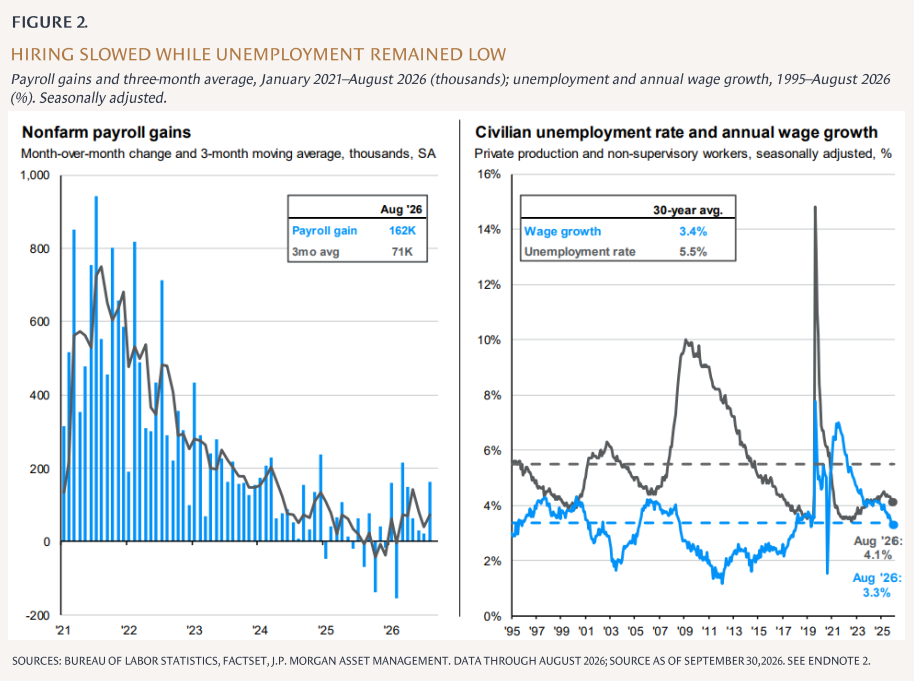
Job growth fluctuated during the quarter, with stronger hiring in August following softer gains earlier in the summer. Unemployment remained relatively low, and the available data pointed to a broadly stable labor market. The stronger August report was encouraging, but hiring over the summer as a whole remained modest, suggesting employers were still cautious about adding workers (see Figure 2).
THE FED RAISED RATES AS INFLATION PERSISTED
Higher energy costs added to inflation during the quarter, while underlying price increases remained above the Federal Reserve’s target. The pressure extended beyond energy, with prices for both goods and services continuing to rise. Against that combination of continued growth and persistent inflation, the Fed raised its policy rate in September after holding it steady earlier in the year.
ECONOMIC OUTLOOK
BUSINESS INVESTMENT SHOULD SUPPORT GROWTH
The U.S. economy should continue growing over the coming quarter and year, supported in part by business investment. Spending on computing capacity, data centers, and supporting infrastructure should further contribute to economic activity. On the other hand, higher borrowing costs could lead businesses to scale back investment.
HOUSEHOLD SPENDING SHOULD CONTINUE TO GROW
Consumer spending should continue to grow, supported by a labor market that is likely to remain broadly stable, even if hiring stays modest. However, slower income growth and higher living costs could restrain purchases, particularly among households that use credit cards or other loans to cover everyday expenses. Furthermore, a meaningful rise in unemployment would likely cause consumer spending to decline.
INFLATION SHOULD EASE GRADUALLY
Inflation should moderate over time, though progress could remain uneven and partly depend on whether energy pressures ease. Productivity gains could help businesses produce more while limiting cost increases. Persistent energy costs or strong demand for labor and materials could delay progress toward lower inflation. Further Fed rate increases remain possible, although easing underlying inflation would reduce the need for additional tightening.
ON THE MINDS OF INVESTORS
WHY HAVEN’T HIGHER INTEREST RATES DERAILED STOCKS?
The 10-year Treasury yield reached its highest level since 2002 during the third quarter, raising reasonable questions about how much pressure higher borrowing costs could place on the economy and financial markets. Bond investors have already felt the impact as bond values have fallen, although higher yields have improved the outlook for future bond returns. Yet the broad U.S. stock market continued to advance. Why have stocks held up, and what would make higher rates more troublesome?
RISING YIELDS REFLECT MORE THAN INFLATION CONCERNS
Most of the increase in the 10-year Treasury yield from the start of the year through September came from higher real yields—yields after accounting for inflation—with comparatively little change in market-implied inflation.³ That suggests the rise was about more than inflation concerns alone. Higher real yields could reflect expectations for tighter monetary policy, greater government borrowing, and the compensation investors require for longer-term lending. Strong demand for capital to fund business expansion could also push yields higher, meaning rising rates may partly reflect economic strength.
THE ECONOMIC IMPACT DEPENDS ON INCOME GROWTH AND EXISTING BORROWING TERMS
Higher rates are easier to absorb when household incomes and business cash flows are growing. A broadly stable labor market has supported household incomes, while rising revenues and productivity gains could help businesses cover additional interest costs without cutting investment or hiring. Interest rates alone therefore do not tell us how much pressure borrowers face.
Existing borrowing terms also determine how quickly higher rates affect spending and investment. A homeowner with a fixed-rate mortgage generally keeps the same principal-and-interest payment, while a new buyer faces today’s financing costs immediately. Businesses with existing fixed-rate debt may likewise have time before higher rates affect their interest expenses, while those refinancing or using floating-rate loans feel the pressure sooner. The greater concern would be rising job losses or weakening business cash flows just as borrowers need to refinance debt at higher rates.
STRONG EARNINGS HAVE HELPED STOCKS WITHSTAND HIGHER RATES

The stock market’s strength also reflects which companies have led the gains. Strong earnings and rising expectations for AI-related profits have helped some of the major technology companies withstand higher rates, while higher oil prices have supported energy companies. The substantial weight of major technology companies in the stock market has allowed their gains to offset weakness elsewhere. The headline return nevertheless concealed wide differences among individual stocks, a pattern also evident in year-to-date results through September (see Figure 3).
This does not mean that AI has made stocks insensitive to interest rates. Improving profit expectations have helped offset the pressure. Still, that support could weaken if major technology companies report disappointing earnings or spending plans that raise doubts about the profits those investments will generate. Further gains will depend partly on whether business results justify investors’ expectations, particularly as financing costs rise.
HIGHER RATES ALSO ENCOURAGE DISCIPLINE
Higher borrowing costs could also encourage greater discipline by making businesses more selective about investment projects and raising the return investors require for taking risk. That could help restrain borrowing based on overly optimistic assumptions, although it does not prevent speculation and could also slow worthwhile investment.
Stocks have held up because earnings strength among influential companies and continued economic growth have helped offset higher rates, while existing financing has delayed the effects on some borrowers. Whether that combination lasts will depend partly on profits meeting expectations and borrowers managing higher costs as their debt is renewed. For long-term investors, rising yields deserve attention alongside those developments. They neither make a market decline inevitable nor become irrelevant simply because stocks have continued to rise.
PORTFOLIO MANAGEMENT
STOCK DIVERSIFICATION LIMITS DEPENDENCE ON MARKET LEADERS
Wide differences in stock returns reinforced the importance of owning companies across industries, sizes, and global markets. A diversified stock portfolio can participate in the success of leading businesses while retaining exposure to companies whose results depend on different sources of demand and investment. This approach may trail a market dominated by a few strong performers, but it limits dependence on those companies continuing to lead.
BONDS SERVE SEVERAL PORTFOLIO NEEDS
Recent losses have been frustrating for bond investors, but short-term price declines do not erase the long-term strategic role bonds play in a balanced portfolio. Higher yields than those available several years ago provide more current income to help meet near-term spending needs. High-quality bonds can also moderate portfolio fluctuations when weakening growth weighs heavily on stocks, especially if inflation eases. Alongside income and liquidity, bonds provide a source of funds for disciplined rebalancing—buying stocks after prices decline (when they are cheaper) to restore the intended allocation and keep the portfolio aligned with long-term goals.
REAL ASSETS HELP ADDRESS INFLATION RISK
Renewed energy pressures highlighted the value of considering how inflation affects the portfolio as a whole. Real assets, including real estate and infrastructure, provide exposure to businesses whose revenues may rise with inflation over time. Higher interest rates could nevertheless weigh on asset values, while borrowing costs and operating expenses could limit income growth. As a complement to stocks and bonds, appropriately sized real asset holdings could help support purchasing power over time.
TAX PLANNING SUPPORTS PORTFOLIO DISCIPLINE
As year-end approaches, losses in bond holdings may create opportunities to realize tax losses in taxable accounts (to offset future capital gains) while preserving the portfolio’s intended exposures. Any transaction should account for applicable tax rules, trading costs, and the investor’s broader tax situation. Tax considerations belong alongside ongoing attention to cash needs and rebalancing, with allocation decisions anchored in long-term objectives.
FAQS
Q:Why haven’t higher interest rates derailed stocks?
Strong earnings among influential companies and continued economic growth have helped offset the pressure of higher rates. Existing fixed-rate borrowing has also delayed the impact on some households and businesses. Broad stock-market gains have nevertheless concealed uneven results, and continued support depends partly on profits meeting expectations as financing costs rise.
Q: Why did bonds decline while stocks advanced in the third quarter?
Rising yields reduced existing bond prices, with longer-term bonds generally experiencing larger losses. Stocks benefited from corporate earnings and continued economic expansion, while AI-related demand supported technology companies and higher oil prices helped energy companies. Those supports allowed the aggregate stock market to advance even as higher rates weighed on bonds.
Q: Why do higher borrowing costs affect some households and businesses sooner than others?
Borrowing terms determine how quickly higher rates affect payments. A homeowner with a fixed-rate mortgage generally retains the same principal-and-interest payment, while a new buyer faces current financing costs. Businesses with existing fixed-rate debt may have time before their costs rise; those refinancing or using floating-rate loans feel the pressure sooner.
Q. What could make higher interest rates more troublesome for stocks?
Higher rates would become more difficult to absorb if business cash flows weakened or job losses increased as borrowers needed to refinance. Disappointing earnings among influential technology companies could also reduce support for the broader market. The concern is how higher financing costs interact with income, profits, and investor expectations.
Q. How do higher yields improve the outlook for bonds after recent losses?
Higher starting yields provide more income and a stronger foundation for future bond returns. That income may help cushion further price declines, although it does not eliminate interest-rate or credit risk. Bonds also retain roles in meeting spending needs, providing liquidity, and supporting disciplined portfolio rebalancing.
Q. What could reduce the need for additional Fed rate increases?
Clearer progress toward lower underlying inflation could reduce the need for further tightening. Easing energy pressures and productivity gains may help limit cost increases. Persistent energy costs or strong demand for labor and materials could slow that progress, leaving additional rate increases possible.
Q. Should I sell my bonds to harvest tax losses?
Realizing losses in taxable bond holdings may offer an opportunity to offset taxable gains while preserving the portfolio’s intended exposures. The decision should account for applicable tax rules, trading costs, and the investor’s broader tax situation. Recent losses alone do not erase bonds’ roles in providing income, liquidity, and funds for rebalancing.
SOURCES & ENDNOTES
1 U.S. Stock returns are represented by the Russell 3000 Index Total Return (TR) USD. International Stock returns are represented by the MSCI All-Country-World Ex-USA Investible Market Index (IMI) Gross Return (GR) USD. U.S. Bond returns are represented by the Bloomberg Aggregate Bond Index Total Return (TR) USD. International Bond returns are represented by the Bloomberg Global Aggregate Ex-USA Dollar-Hedged Index Total Return (TR) USD. Third-quarter returns cover July 1–September 30, 2026; year-to-date returns cover January 1–September 30, 2026. Total returns include reinvested income. International stock returns are expressed in U.S. dollars without currency hedging; international bond returns are hedged to the U.S. dollar. Indexes are unmanaged and cannot be invested in directly. Past performance is not indicative of future results.
2 J.P. Morgan Asset Management, Guide to the Markets — U.S., Fourth Quarter 2026, page 18, “Labor market dynamics.” Sources: Bureau of Labor Statistics and FactSet. Payroll panel: month-over-month change in total nonfarm payroll employment and its three-month moving average, in thousands, January 2021–August 2026. Second panel: civilian unemployment rate and annual wage growth for private production and nonsupervisory workers, in percent, 1995–August 2026. All series are seasonally adjusted. The wage measure applies to private production and nonsupervisory workers, not to the unemployment series; these workers represent just over 80% of total private nonfarm jobs. Dashed lines show the source’s 30-year averages. Data through August 2026; source as of September 30, 2026. All plotted observations are historical, not forecasts.
3 AllianceBernstein analysis using Bloomberg data, December 31, 2025–September 30, 2026. Real yields are represented by yields on Treasury Inflation-Protected Securities; market-implied inflation reflects the difference between nominal and real Treasury yields. This difference can also reflect inflation-risk and liquidity premiums and is not a pure forecast of inflation.
4 AllianceBernstein, “Increasing Dispersion May Yield Broader Opportunities: Selectivity Is Key,” left panel, “Headline Index Returns Do Not Capture the Whole Story.” Sources: FactSet and S&P. Data through September 30, 2026. Stocks are ranked by year-to-date return. The S&P 500 Index headline return is a price return and excludes dividends; it therefore differs in methodology from the total returns in Figure 1. The distribution shows individual stock returns, not their weighted contributions to the index. It does not establish that higher interest rates caused the differences in returns. Past performance and current analysis do not guarantee future results.
IMPORTANT DISCLOSURE INFORMATION:
The following is general commentary on the markets and economy and reflects our opinions and expectations as of October 2026. It does not constitute personalized investment advice, an offer to sell, or a solicitation of an offer to buy any securities or investment products. The views and opinions expressed are those of Capstone Financial Advisors and are based on information believed to be reliable; however, the accuracy and completeness of such information are not guaranteed and are subject to change without notice. Investment advisory services are offered through Capstone Financial Advisors, a registered investment adviser with the U.S. Securities and Exchange Commission (SEC). Registration does not imply a certain level of skill or training. Capstone Financial Advisors may have business relationships or conflicts of interest that could influence the services we provide. Additional information about these relationships can be found in our Form ADV. Any forward looking statements or projections are based on current assumptions and are not guarantees of future performance. Past performance is not indicative of future results. All investments involve risk, including the potential loss of principal. Please review our Form ADV for more information about our services, fees, and potential conflicts of interest. If you have any questions or need further information, please contact us at capstonefinancialadvisors@capstone-advisors.com or (630) 241 0833.